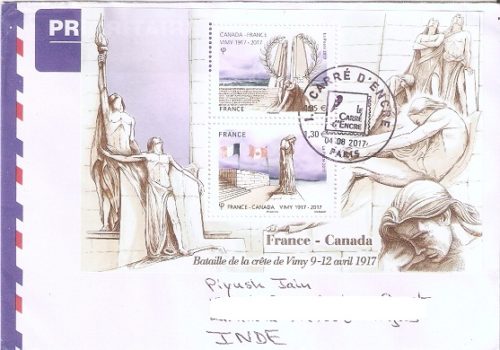
This MS ,issued by France ,which includes a joint French- Canadian stamp issued ,pertains to the event on 29th June 1922 , when the Government of France granted “one square kilometer” of land at Vimy Ridge “freely, and for all time, to the Government of Canada, the free use of the land exempt from all taxes”,to build a memorial to the brave Canadian troops who fought at the Battle of Vimy Ridge ,during WW I .
Many historians and writers consider the Canadian victory at Vimy a defining moment for Canada, when the country emerged from under the shadow of Britain and felt capable of greatness. Canadian troops also earned a reputation as formidable, effective troops because of the stunning success. But it was a victory at a terrible cost, with more than 10,000 killed and wounded.
This battle was planned with the Canadian Corps in France being ordered to seize Vimy Ridge ,in April 1917.
Situated in northern France, the heavily-fortified seven-kilometre ridge held a commanding view over the Allied lines. The Canadians attack took place over an open graveyard ,since previous French attacks had failed with over 100,000 casualties.
To capture this difficult position, the Canadians carefully plan and rehearsed their attack. To provide greater flexibility and firepower in battle, the infantry were given specialist roles as machine-gunners, rifle-men and grenade-throwers.
Many historians and writers consider the Canadian victory at Vimy a defining moment for Canada, when the country emerged from under the shadow of Britain and felt capable of greatness. Canadian troops also earned a reputation as formidable, effective troops because of the stunning success. But it was a victory at a terrible cost, with more than 10,000 killed and wounded.
The Canadian Corps was ordered to seize Vimy Ridge in April 1917.
The heavily-fortified seven-kilometre ridge held a commanding view over the Allied lines. The Canadians started the assaulti over an open graveyard ,since previous French attacks had failed with over 100,000 casualties.
To capture this difficult position, the Canadians hsfcto carefully plan and rehearse their attack. To provide greater flexibility and firepower in battle, the infantry were given specialist roles as machine-gunners, rifle-men and grenade-throwers.
In the week leading up to the battle, Canadian and British artillery pounded the enemy positions on the ridge, killing and tormenting defenders. New artillery tactics allowed the gunners to first target, then destroy enemy positions. A nearly limitless supply of artillery shells and the new 106 fuse, which allowed shells to explode on contact, as opposed to burying themselves in ground, facilitated the destruction of hardened defences and barbed wire.
Attacking together for the first time, the four Canadian divisions based in France, stormed Vimy Ridge at 5:30am on 9 April 1917. More than 15,000 Canadian infantry overran the Germans all along the front. Incredible bravery and discipline allowed the infantry to continue moving forward under heavy fire, even when their officers were killed.There were countless acts of sacrifice, as Canadians single-handedly charged machine-gun nests or forced the surrender of Germans in protective dugouts. Hill 145, the highest and most important feature of the Ridge, and the place where the Vimy monument now stands, was captured in a frontal bayonet charge against machine-gun positions. Three more days of costly battle delivered the final victory. The Canadian operation was an important success, even if the larger British and French offensive, of which it had been a part, had failed. But it was victory at a heavy cost, as 3,598 Canadians were killed and another 7,000 wounded.
The capture of Vimy was more than just an important battlefield victory. For the first time all four Canadian divisions attacked together,and these units included men from all regions of Canada . Brigadier-General A.E. Ross declared after the war, “in those few minutes I witnessed the birth of a nation.”